
Sleep elasticity: why most of sleep may have no function at all
Sleep is universal, it is defended whenever you take it away, and it looks expensive. For half a century those three facts have been read as a single message: sleep must be doing something vital, and we have simply not worked out what yet.
The search has not converged. It has produced a dozen candidate functions (synaptic downscaling, metabolite clearance, memory consolidation, immune support, energy conservation, and more), each defensible in the setting where it was found, none commanding general assent. Fifty years in, that is not what a field looks like when it is closing on an answer.
The question does the damage
We ask what the function of sleep is, and the trouble is in the definite article. It presupposes that there is one function, that it is the same in a jellyfish and in a human, and that whatever it turns out to be, it justifies spending a third of a life insensible to the world.
Evolution does not optimise function. It optimises fitness. Ask instead what fitness sleep confers, and to whom, and the expectation of a single answer disappears. Different advantages can accrue to different lineages, at different times, layered on top of one another.
Three components, one state
In a new preprint I set out what I call the sleep elasticity hypothesis.
An accessory component came first, an ecological buffer that keeps an animal safely and economically inactive through the hours when activity would not repay itself. It discharges no cellular transaction. It has no biochemical function at all, only ecological value, and in most species it is the largest part of the night.
Onto that pre-existing state, individual lineages have since loaded useful processes, memory consolidation in some, immune or metabolic work in others. These are exaptations, recruited onto something that was already there for other reasons. What a species does with its sleep is therefore a fact about the species, and not about sleep.
Whether a third, genuinely vital component exists is a question I hold open rather than answer. If it turns out to be empty, the framework stands with two layers.
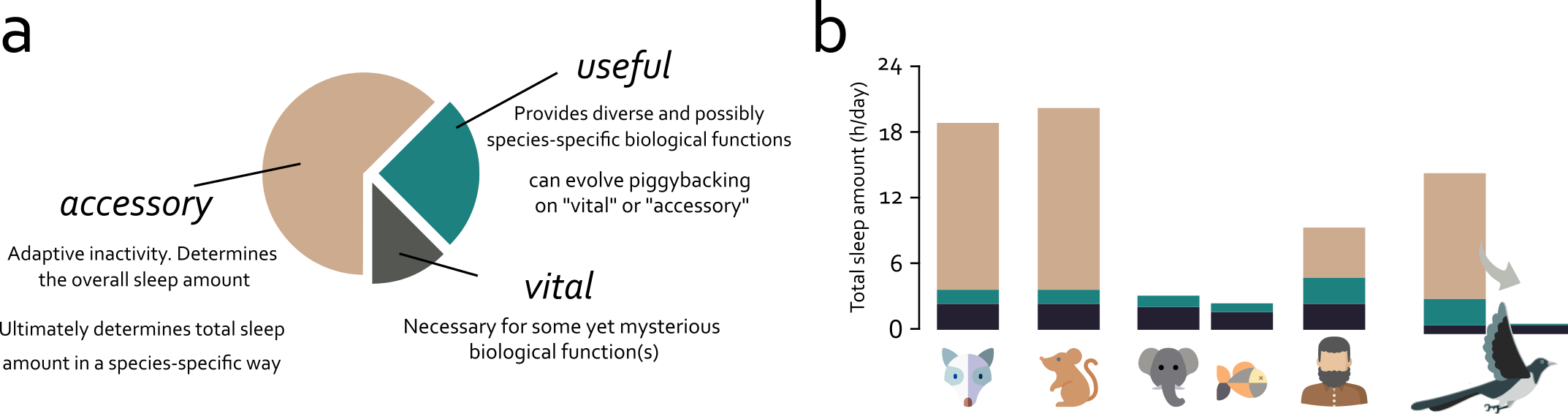
The name comes from economics, where an elasticity measures how strongly one quantity responds to a change in another. Most of sleep stretches and contracts with ecology. A small part may not move at all.
Why this matters
It explains why the field is stuck. If sleep is a mixture rather than a thing, then every study measuring “sleep” has been measuring a different blend of three components, and the dozen incompatible functions in the literature are exactly what you would expect to find. The contradictions stop being a scandal and start being data.
It makes total sleep duration close to meaningless. Hours on the clock are a compound of amount set by ecology and opportunity, timing by the circadian system, depth by whatever physiological work is being done, and a residue that bounds any indispensable core. Comparing species by how long they sleep, or people by whether they manage eight hours, is comparing sums of quantities that are not the same across the things being compared.
It turns the field’s most embarrassing observations into predictions. The migrating bird that sheds sleep for weeks and never repays it, the cavefish that has lost most of its sleep but kept the homeostat that would defend it, the fur seal that abandons one sleep state at sea while still defending the other: these are anomalies only if sleep is one indispensable thing. Under a layered account they are the expected result of different lineages carrying different loads.
It tells experimentalists what to measure instead. Depth read as arousal threshold, rather than as slow-wave power, is the most promising route to pulling the three components apart. Slow waves are a mammalian signature. Arousal threshold can be measured in anything that behaves, which is what a comparative account of sleep actually needs.
What would sink it
I have tried to state this so it can lose. The paper sets out each claim with the evidence for it, the leading alternative reading, the confidence it warrants, and the observation that would decide it.
The honest weakness is measurement. Nobody can currently decompose an animal’s sleep into accessory, useful and vital parts, and devising a way to do it is the most important experimental challenge the framework sets. Until then the proportions I draw remain a hypothesis, not a result.
A reader who expects a vital core to be found eventually is not refuting this. They are proposing a value for one of its terms.
Links and further material



The elastic, tripartite model was first sketched in 2018 and has been under continuous development since, improved beyond recognition by everyone in my laboratory and by the many colleagues who argued with it at meetings and in seminars over the years. I talked about some of these ideas on multiple podcasts and interviews. Below, the Max Planck Florida’s Neurotransmissions podcast, in an episode titled “Could Sleep be Nature’s Time-out?”.